

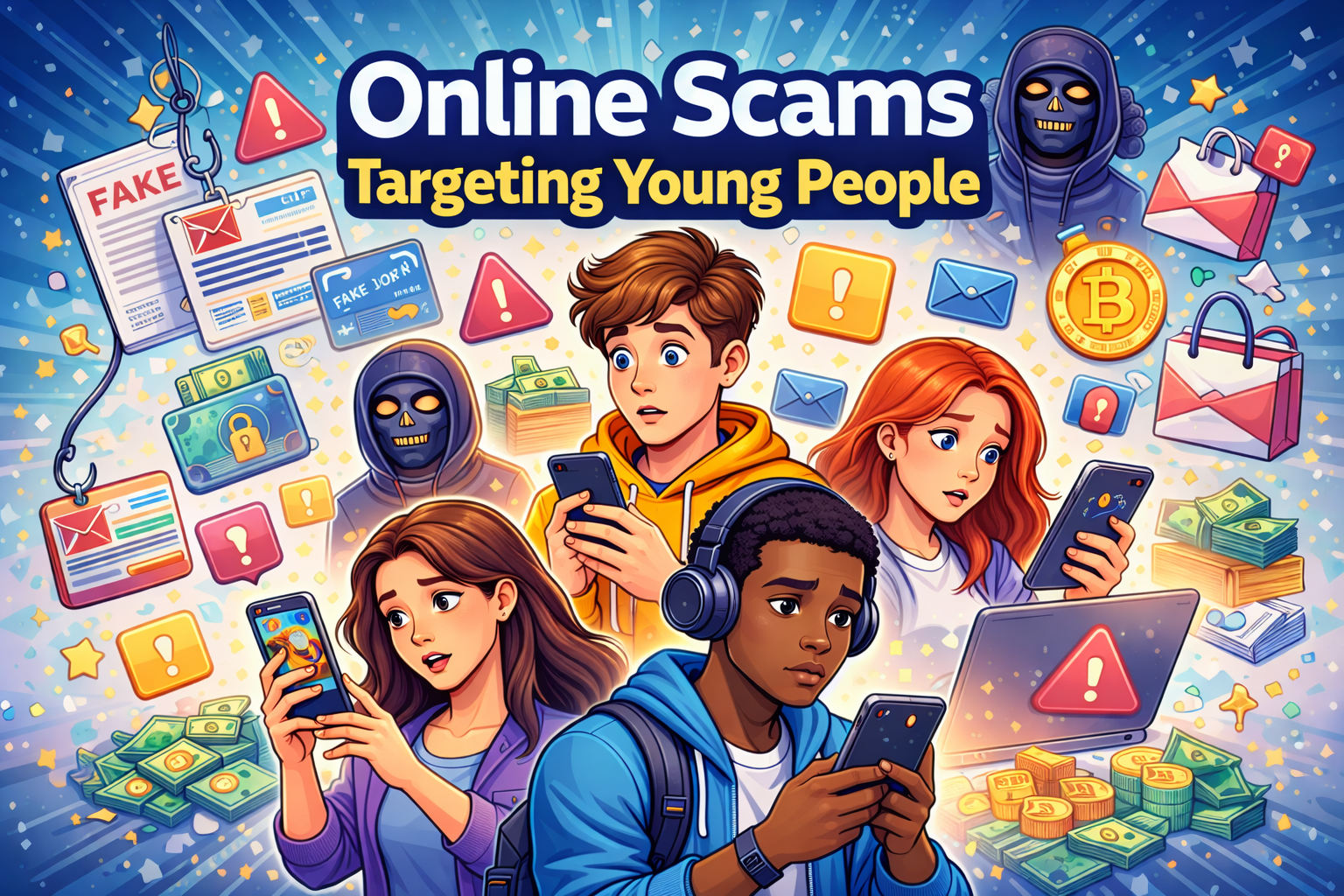
Online scams targeting young people are increasing worldwide as more students and young professionals explore remote jobs, cryptocurrency investing, and ways to make money online.
Young people across the United States, United Kingdom, Canada, Australia, and other digitally connected economies are actively exploring remote jobs, freelancing platforms, cryptocurrency investing, and online business opportunities.
The internet has made it easier than ever to make money online, build independent income streams, and work from home. But at the same time, online scams have become more advanced, more personalized, and more financially damaging.

Cybercriminals don’t randomly choose victims. They target ambitious individuals searching for legit online jobs, investment growth, or passive income ideas.
This guide breaks down the top online scams, how they operate, and how you can protect your identity, bank accounts, and digital assets while still pursuing real online income opportunities.
This isn’t about fear. It’s about smart digital decision-making.
1. Fake Remote Job & Work From Home Scams
Remote work is one of the fastest-growing job sectors in the US and other Tier-1 countries. Unfortunately, remote job scams and fake work-from-home offers are increasing at the same pace.
You might receive:
- A high-paying remote job offer with minimal qualifications
- A quick “text interview”
- Immediate hiring without proper screening
Then comes the request:
- A training fee
- A software setup charge
- An equipment deposit
The Federal Trade Commission regularly warns about advance-fee employment fraud affecting job seekers.
Important: Legitimate employers never charge applicants.
If you are searching for legit online jobs in the USA or globally, always verify company registration and reviews before engaging.
2. Phishing Emails & Identity Theft Attacks
Phishing remains one of the most profitable forms of online fraud worldwide.
You may receive emails claiming:
- “Your bank account is suspended.”
- “Suspicious login detected.”
- “Verify your payment details immediately.”
The fake website captures your login credentials, leading to identity theft, credit card fraud, or bank account takeover.
Young professionals and students are frequent targets because they manage multiple online accounts.
To strengthen identity theft protection:
- Always Create secure Gmail account
- Enable two-factor authentication (2FA)
- Avoid clicking urgent links
- Use official website URLs manually
Cybersecurity awareness is your first layer of financial defense.
3. Cryptocurrency Investment & Online Trading Scams
Cryptocurrency investing continues to attract young investors hoping for high returns.
The Securities and Exchange Commission frequently issues alerts regarding crypto pump-and-dump schemes and unregistered digital asset offerings.
Common pattern:
- Private Telegram or Discord group promotes a “hidden gem coin.”
- Influencers show screenshots of profits.
- Price spikes.
- Organizers sell.
- Late investors suffer losses.
If someone promises guaranteed crypto returns or “risk-free trading,” it is a major red flag.
Crypto can be legitimate — but volatility means no one can guarantee profits.
4. Social Media Trading Gurus & Forex Signal Scams
On platforms like Instagram and TikTok, you’ll often see influencers advertising:
- Forex trading signals
- Crypto mentorship programs
- VIP investment groups
- Daily guaranteed returns
These schemes often generate income through subscriptions, not trading success.
Real investing requires:
- Risk management
- Education
- Long-term strategy
If profits look effortless and lifestyle marketing is the main hook, proceed cautiously.
5. Romance & Emotional Manipulation Scams
Romance scams are financially and emotionally devastating.
A connection forms online. Conversations become personal. Trust develops.
Then comes:
- A medical emergency
- Travel problem
- Investment opportunity request
Funds are requested through wire transfer, gift cards, or cryptocurrency.
If someone you have never met in person asks for financial help, pause and verify independently.
Emotional pressure is often the strongest manipulation tool scammers use.
6. Fake Online Shopping & E-Commerce Fraud
AI tools now allow scammers to build realistic online stores quickly.
Organizations like the Better Business Bureau report increasing complaints about fake online retailers.
Red flags include:
- Massive 80–90% discounts
- No verified customer service
- Newly registered domains
- Only prepaid payment options
For credit card fraud protection, use secure payment gateways and avoid unfamiliar websites offering unrealistic deals.
7. Scholarship & Financial Aid Scams
Students searching for grants and financial support are prime targets.
Fake websites promise guaranteed scholarships in exchange for processing fees.
Legitimate institutions do not sell approval.
Always confirm through official government or university portals before submitting payment.
8. Online Gaming & Digital Asset Theft
Young gamers are often targeted with:
- Free currency generators
- Premium skin unlockers
- Account boosting services
These typically require login credentials, leading to stolen accounts and digital asset loss.
No reputable gaming company distributes premium features through third-party generators.
9. AI Voice Cloning & Deepfake Fraud
AI technology has introduced new scam tactics.
Imagine receiving a phone call that sounds exactly like your manager asking for urgent payment.
The voice may be AI-generated.
Before transferring funds:
- Verify via a second communication method
- Never respond to urgent financial pressure without confirmation
As AI evolves, verification becomes essential for online fraud prevention.
10. “Make Money Online Fast” Schemes
Many young people search for ways to make money online safely and quickly.
Scammers exploit this ambition with:
- Paid “secret income systems”
- Fake affiliate marketing promises
- Pyramid-style referral programs
- Dropshipping shortcuts guaranteeing profits
There is no instant wealth formula.
Sustainable online income requires:
- Skill development
- Consistency
- Patience
- Realistic expectations
If a system guarantees income without effort, it’s likely designed to benefit the seller — not you.
Why Young People Are Frequently Targeted
Young adults:
- Spend more time online
- Explore remote income opportunities
- Experiment with crypto investing
- Trust online communities
Scammers use urgency, authority pressure, and emotional manipulation to override rational thinking.
Awareness disrupts that strategy.
How to Make Money Online Safely
If your goal is legitimate online income:
- Learn high-demand digital skills (SEO, coding, content writing, design).
- Use verified freelance platforms.
- Avoid opportunities requiring upfront payment.
- Research companies thoroughly.
- Protect banking credentials and OTP codes.
- Maintain strong cybersecurity habits.
Online income is possible — but it is never guaranteed or instant.
Frequently Asked Questions (FAQ)
1. What are the most common online scams targeting young people ?
Remote job scams, cryptocurrency investment fraud, phishing attacks, identity theft schemes, and social media trading scams are among the most common globally.
2. How can I verify if an online job is legitimate?
Check the company’s official website, verify domain age, read independent reviews, confirm physical address details, and never pay upfront fees.
3. Are cryptocurrency investment opportunities always scams?
No. Cryptocurrency itself is not a scam. However, guaranteed returns, unregistered investment schemes, and pump-and-dump promotions are major red flags.
4. How do I protect myself from identity theft online?
Enable two-factor authentication, use strong passwords, avoid suspicious links, and monitor financial statements regularly.
5. Is it possible to make money online safely?
Yes. Legitimate online income is achievable through skill-based freelancing, remote employment, content creation, and digital services — but it requires effort and patience.
Final Thoughts
The digital economy offers powerful opportunities for young people worldwide. But financial growth must be balanced with cybersecurity awareness.
Before clicking, investing, or transferring money, ask:
Is this verified?
Is this realistic?
Am I being pressured to act immediately?
The smartest digital generation won’t be the fastest earners — it will be the most informed and financially protected.
Protect your identity.
Protect your money.
Protect your future.